Fotona Endotight provides a non-surgical option for full-face rejuvenation, ideal for individuals with moderate skin sagging who prefer to avoid facelift procedures.
The Nd:YAG wavelength is used to tighten skin by creating vectors in the subdermal (SMAS) layer, mimicking SMAS plication and tightening facial ligaments for a firmer appearance.
The original protocol for this procedure has its roots on laser lipolysis. This procedure was primarily used to reduce fat deposits, but it did produce some, albeit variable, skin tightness.
The facelift procedure was first known as endolift. This technique became feasible with the development of ultra-thin optical fibers that deliver laser energy to the superficial musculoaponeurotic system (SMAS). The SMAS is a fibromuscular layer in the face that separates superficial and deep facial structures. It plays a vital role in supporting facial contours by connecting muscles and skin.
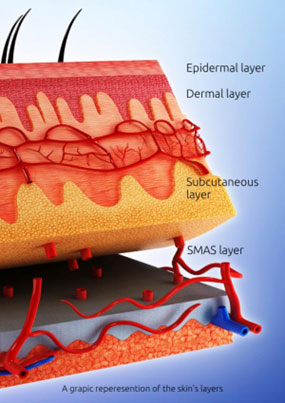
The procedure involves the creation of a small entry point along the lateral midfacial region, through which both local anesthetic solution and a thin fiber delivery system are introduced. The fiber is advanced within the subdermal plane, allowing for controlled delivery of laser energy to a specified temperature. For patients presenting with mild skin laxity, a single treatment session is typically sufficient. However, individuals with moderate laxity may require multiple sessions to achieve optimal results.
The Fotona Endotight procedure is effective for tightening areas such as the face, neck, underarms, abdomen, and the crepey skin above the knees. The improvements develop gradually over several months, much like the effects seen with Sculptra treatment.
At MLA, alongside the Endotight procedure, we employ the T-runner to enhance superficial tightening by specifically addressing more superficial facial layers. Additionally, fractional resurfacing is incorporated to rejuvenate the skin, improve pigmentation uniformity, and address photodamage, contributing to a more youthful complexion.
Following the procedure, patients use a support garment to boost blood flow, lessen muscle vibration, and accelerate recovery by decreasing discomfort.